THE ICONIC’s Major API Upgrade: What It Means for Marketplace Sellers
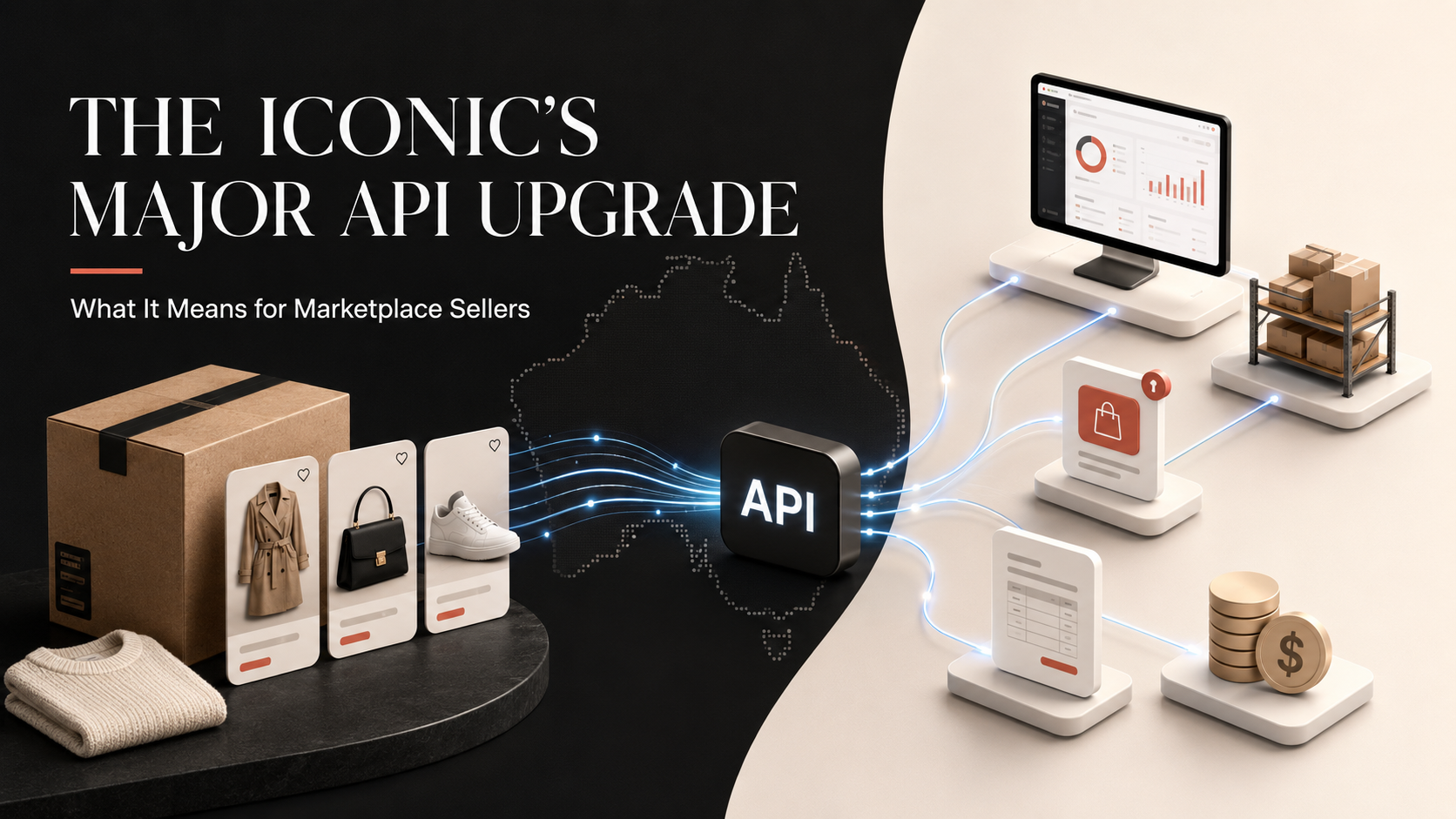
THE ICONIC Marketplace in Australia has introduced a major upgrade to its Seller Center API. This is more than a technical change.
THE ICONIC Marketplace in Australia has introduced a major upgrade to its Seller Center API.
This is more than a technical change. The new API expands the automation possibilities available to sellers, making it easier to connect THE ICONIC with ERP, PIM, OMS, warehouse and accounting systems.
From real-time order notifications to bulk catalogue operations and financial reconciliation, the upgrade could reduce manual work across several important marketplace processes.
Let’s examine the major new capabilities and what they could mean for sellers.
1. More secure connections with OAuth 2.0
What is changing?
The new API uses OAuth 2.0 applications, access tokens and permission-based access instead of relying primarily on long-lived API keys.
Access tokens are issued to authorised applications and expire automatically, while permissions determine which information and operations an application can access.
What is the impact on sellers?
OAuth 2.0 provides sellers with a more secure and manageable way to connect THE ICONIC with external systems such as:
ERP platforms
Product Information Management systems
Order Management Systems
Warehouse and fulfilment systems
Accounting platforms
Marketplace integration applications
This should improve credential security, simplify access management and reduce the risks associated with sharing permanent API keys.
Existing sellers using THE ICONIC’s legacy API may need to create a new OAuth application and reconnect their current integration. Token renewal should normally be managed automatically by the integration provider.
Read THE ICONIC’s OAuth documentation :
The Iconic API
2. Real-time notifications through webhooks
What is changing?
The new API supports webhook notifications for events such as:
New order created
Order-item status changed
Return status changed
Product created or updated
Product quality-control status changed
Product or inventory feed completed
Previously, an integration often had to check THE ICONIC repeatedly to discover new orders or other changes. With webhooks, Seller Center can notify the connected system as soon as a relevant event occurs.
What is the impact on sellers?
Orders and marketplace updates can reach the seller’s systems much faster.
For example, when a customer places an order, THE ICONIC can notify the seller’s integration immediately. The order can then be created automatically in the seller’s ERP, OMS or warehouse system without waiting for the next scheduled synchronization.
This could help sellers:
Import orders faster
Reserve inventory sooner
Reduce the risk of missing new orders
Start fulfilment earlier
Identify product rejections more quickly
Receive return updates without manually checking Seller Center
Reduce unnecessary API polling
Webhooks are especially valuable for sellers operating under strict order-fulfilment timelines. A periodic reconciliation process should still be used as a backup in case a webhook is delayed or missed.
3. Improved product, variant and colour-group management
What is changing?
The new API provides more structured support for:
Product sets
Individual sizes and variants
Product groups
Colour grouping
Product images
Categories
Product attributes
Product quality-control information
This structure is particularly relevant to fashion, footwear and lifestyle catalogues, where one product style may be available in several colours and sizes.
What is the impact on sellers?
Sellers should be able to represent relationships between products more accurately.
For example, a shirt may have:
One common product style
Three colours
Five sizes under each colour
Shared product information
Variant-level SKU and inventory data
Better product grouping could help reduce:
Duplicate product pages
Incorrect parent–variant relationships
Sizes appearing as unrelated products
Incorrect colour grouping
Inconsistent product information
The new API also includes product quality-control status events. This could enable connected systems to show whether a submitted product is:
Awaiting review
Approved
Rejected
Waiting for correction
Resubmitted
As a result, catalogue teams may be able to identify rejected products earlier, correct the issues and reduce delays when launching new collections.
4. Faster and more flexible bulk catalogue operations
What is changing?
The new API supports asynchronous CSV and XLSX imports for:
Product creation
Product updates
Product removal
Inventory updates
Image updates
XML-based product operations are also available.
Instead of waiting for every product to be processed during the original request, the seller submits a feed and receives a feed ID. The integration can then monitor the feed until processing is complete.
What is the impact on sellers?
Large catalogues can be uploaded and updated more efficiently.
This is useful for:
Initial marketplace onboarding
Seasonal collection launches
Large inventory updates
Product catalogue migrations
Bulk image replacements
End-of-season product removal
A connected system could display the progress of each operation:
Submitted → Processing → Completed
It could also identify feeds that completed with warnings or failed because of product-data errors.
This gives sellers better visibility into whether their product, stock or image updates were successfully accepted. It also reduces situations where a seller assumes a feed was processed when some records were actually rejected.
5. Order invoice-number synchronisation
What is changing?
The new Order Invoicing API allows sellers to generate invoice numbers within Seller Center or assign invoice numbers produced by an ERP or accounting system to THE ICONIC order items.
It includes operations for:
Generating an invoice number
Retrieving invoice-number settings
Updating invoice-number settings
Assigning an invoice number manually
Providing electronic invoice access information in applicable regions
It is important to note that this API primarily manages invoice numbers and invoice references. It does not necessarily generate a complete, legally compliant Australian tax-invoice PDF.
What is the impact on sellers?
For sellers using an ERP or accounting system, the typical flow could be:
THE ICONIC order received
→ Sales order created in ERP
→ Order fulfilled
→ Invoice created in ERP
→ Invoice number sent back to THE ICONIC
This could help sellers:
Push ERP-generated invoice numbers back to THE ICONIC
Avoid manually entering invoice references in Seller Center
Keep marketplace orders and accounting invoices connected
Maintain consistent invoice information across items in the same package
Reduce invoice-number mismatches
Improve customer-service traceability
Maintain a better audit trail
The API also contains invoice access-key and XML capabilities. However, these appear more relevant to countries with government-authorised electronic invoicing and may not be enabled for most Australian sellers.
Explore THE ICONIC’s Order Invoicing API.
6. Financial operations and settlement reconciliation
What is changing?
THE ICONIC’s Financial Operations API provides access to financial statements and transaction-level information.
Depending on the seller’s permissions and available transaction types, this data could include:
Product sales
Commissions
Refunds
Marketplace fees
Adjustments
Other debits and credits
The API also supports access to information such as:
Closed financial statements
Current statement summaries
Opening and closing balances
Expected payout amounts
Statement transaction breakdowns
Order-item-related transactions
Debit and credit classifications
What is the impact on sellers?
Finance teams could automatically retrieve THE ICONIC statements and transactions instead of manually downloading and processing reports.
This may allow sellers to:
Track expected payouts
Compare marketplace sales with actual settlement amounts
Monitor open and closed statements
Match transactions with orders and products
Separate sales, commissions, refunds and fees
Automate accounting entries
Identify payout discrepancies
Reduce spreadsheet-based reconciliation
Integration platforms could use this data to create entries in accounting and ERP systems such as:
QuickBooks
Xero
Microsoft Dynamics 365 Business Central
NetSuite
SAP
Odoo
Other accounting and ERP platforms
A settlement workflow could automatically:
Retrieve THE ICONIC’s financial statement.
Import the underlying transactions.
Match transactions with marketplace order items.
Separate sales, refunds, commissions and adjustments.
Compare the calculated amount with the expected payout.
Post the appropriate entries into the seller’s accounting system.
Flag unmatched transactions for manual review.
This could be one of the most valuable improvements for medium and enterprise sellers because marketplace settlement reconciliation is often time-consuming and heavily dependent on spreadsheets.
What THE ICONIC’s API upgrade means overall
THE ICONIC’s new API represents a transition from basic marketplace connectivity towards deeper commerce automation.
The upgrade gives sellers and integration providers the foundation to automate more of the marketplace lifecycle, including:
Product creation and catalogue management
Inventory updates
Real-time order notifications
Product approval monitoring
Order invoicing
Returns
Warehouse operations
Financial statements
Settlement reconciliation
Once these capabilities are enabled for seller accounts, businesses should be able to connect THE ICONIC more deeply with their ERP, PIM, OMS, warehouse and accounting systems.
This could reduce manual work across catalogue management, order processing, fulfilment, invoicing and financial reconciliation.
What should existing THE ICONIC sellers do?
Sellers should review their existing integration and determine:
Whether it currently uses THE ICONIC’s legacy or V2 API
Whether migration to OAuth 2.0 will be required
Which API permissions are available to their seller account
Whether webhooks can reduce frequent order polling
Whether product QC updates can be automated
Whether ERP invoice numbers can be synchronized
Whether statements and settlements can be reconciled automatically
Whether their ERP or integration provider supports the new API
Connect THE ICONIC with your commerce systems
Commercium by Constacloud can help sellers connect THE ICONIC’s new API with their ERP, eCommerce platform, PIM, warehouse, accounting system and other sales channels.
From products, variants and inventory to orders, fulfilment, returns and marketplace settlements, businesses can manage THE ICONIC as part of one connected commerce operation.
Want to understand how THE ICONIC’s new API could work with your existing systems? [Talk to the Commercium team].
Put this into practice
Connect 200+ marketplaces with one no-code connector and keep every channel in sync.